Research Groups & Initiatives
Faculty within the College of Education and Human Development are involved in many research groups and initiatives with far-reaching impact.
Ongoing Initiatives
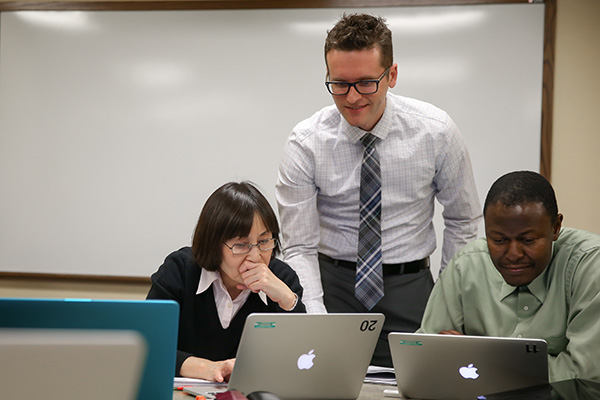
The Faculty Motivation Research Group (FMRG) works towards optimal performance by higher education faculty by examining the factors that affect success, such as motivations and emotions.

Project LATINE focuses on Latinx advancement, training, and inclusion in engineering.
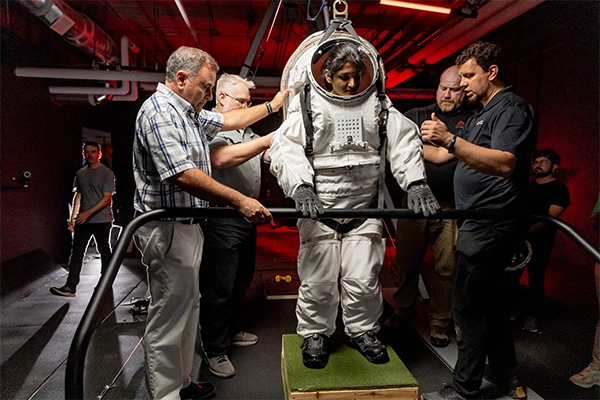
The BiPed Lab uses state-of-the-art motion capture, technology and biomechanics to improve teaching.
Grant Research Projects
CEER is a collaboration between UND's College of Education & Human Development and College of Engineering & Mines, with the aims of transforming PK-20 engineering education and broadening pathways to engineering through research partnerships and outreach.
Project CuRRENT is a collaboration with Turtle Mountain Community College and the International Water Institute (IWI). It provides professional learning to elementary teachers in place-based, interdisciplinary curriculum focused on local watersheds to Indigenize STEM instruction.
GRO.UND provides healthy and locally grown produce to increase food security in the UND community. The program teaches sustainability education, plants, grows and harvests produce, and supports UND Food for Thought, a food pantry for UND students.
The iCARE Lab is dedicated to advancing cancer prevention and health promotion through innovative research, education, and community engagement. Through interdisciplinary research, community partnerships, and evidence-based education, they aim to improve cancer awareness, promote healthy behaviors, and translate scientific research into meaningful public health action.
The Knowledge Utility and Access (KUA) initiative is a three-year grant project dedicated to supporting Indigenous educators in rural tribal schools. Through culturally grounded professional development (STEAM), mentorship, wellness gatherings, and leadership opportunities in mentoring, KUA aims to enhance teacher resilience by strengthening cultural identities, connection to the land, and spirit—thereby increasing long-term teaching impact and sustainability.
ND HOPES is a suicide prevention project spanning a 21-county jurisdiction in Western North Dakota. Funded by the Centers for Disease Control and Prevention, ND Hopes is a multi-tiered preventative effort that targets disproportionately affected populations (DAPs) including rural residents, veterans, and youth.
The Field-Based and Participatory Qualitative Research Lab ("Qual Lab") advances methodological and theoretical work in field-based and participatory qualitative research through collaborative scholarship, faculty and student mentorship, and community-engaged inquiry that centers lived experience, relational research practices, and inclusive knowledge production.
STEM STRONG (Supporting Teachers in Rural cOmmunities for the Next Generation) is a four-year, $2.9M project that is dedicated to providing STEM instructional supports to rural teachers across four states. In addition to initial intensive training, participants will receive structured periodic supports and reinforcements to boost retention and provide meaningful, long-term learning.
The Trauma, Substance, Justice, and Recovery (TSJR) Lab focuses on the syndemic (overlapping epidemics) of trauma exposure, substance misuse, and justice involvement, and aims to generate research to delineate pathways and identify supports to mental health recovery, including recovery from substance use disorder.